How to Get a Half Dome Permit in 2026: Lottery Odds, Daily Lottery Hack, and Plan B Alternatives
Last updated: April 17, 2026
Climb the last 400 feet of Half Dome and your hands leave the granite for the steel cables, your boots find the wooden planks bolted between them, and the Valley drops 4,800 feet to the meadows below. That moment is why the National Park Service rations 300 people a day up the cables. Getting one of those 300 spots is the hard part, and in 2026, it’s about to get harder.
If you’re chasing a Half Dome permit 2026, you have two real shots at the lottery and one realistic Plan B. This guide walks through the numeric odds by date, the daily lottery timing most blogs still get wrong, and the America 250 crowd surge that’s already skewing the math. By the end, you’ll know exactly which dates to apply for, which to skip, and what to hike instead if the lottery breaks your heart.
Half Dome Permit 2026 at a Glance
Here’s the short version before the deep dive.
- Cable season (projected 2026): May 22 to October 13. NPS rule is the Friday before Memorial Day through the day after the second Monday in October, and 2026 dates are pending official NPS confirmation.
- Preseason lottery window: March 1 to March 31, 2026, Eastern time. Results land mid-April.
- Daily lottery window: Midnight to 4:00 PM Pacific, two days before your hike date. Results post late the same night.
- Cost: $10 non-refundable application fee, plus $10 per permit (per person) if you win.
- Cap: 300 permits per day. 225 day hikers, 75 backpackers.
- Which lottery should you enter? Both. Flexible dates go preseason first. Rigid dates stack preseason + daily + a Plan B hike on the same trip.
What Half Dome Permits Actually Are (and Why You Need One)
A Half Dome permit isn’t a general hiking pass. It’s specifically for the 400-foot cable route from the subdome to the summit, the stretch of exposed granite the NPS locks down with steel rails from late May through mid-October. Without one, you can hike the 16-mile round-trip approach up the Mist Trail, past Vernal and Nevada Falls, through Little Yosemite Valley, right up to the base of the subdome. You just can’t go higher.
The cable route has been permit-regulated since 2010, after weekend crowds made the cables dangerous on their own. Before the system, rangers counted more than 1,000 people on the cables on peak Saturdays, a density that turned a steep scramble into a standstill at the most exposed point. Today’s cap is 300 total per day: 225 day hikers and 75 backpackers. Most of the 225 day-hiker permits go through the preseason lottery; a smaller tranche is held for the two-day daily lottery.
Hiking the cables without a permit violates 36 CFR 1.6. The statutory max is $5,000 and up to 6 months in jail. In practice, hikers have reported $280 field citations. Rangers check permits at the base of the subdome, and the named permit holder (or a listed alternate) has to be present with the group. No transfers. No friend-of-a-friend handoffs. Our 2026 national park reservation guide covers the broader lottery landscape, but Half Dome sits at the strictest end of the spectrum.
(Rangers are usually chill about questions at the subdome check. They are not chill about missing permits. Plan accordingly.)
The Preseason Lottery: Your Best Shot
The preseason lottery is the single biggest lever you have. It runs March 1 to March 31, 2026 (Eastern time), with results announced mid-April. One application costs $10 non-refundable, covers up to six people, and lets you list up to seven date choices (either specific dates or a date range). If you win, you pay $10 per permit awarded.
A quick note on the data that follows: NPS has not yet published 2025 lottery statistics as of April 2026 (the prior-year stats typically drop by mid-summer), so the figures in this section are drawn from the 2024 season. Reassuringly, 2023 and 2024 rates were within a single percentage point of each other, so these are reliable directional numbers for your 2026 planning. We’ll refresh this guide when NPS posts the 2025 data. In 2024, the preseason lottery saw 35,289 applications and an overall 22% success rate. Here’s the piece most hiking blogs miss: that 22% figure is an average across all dates. Weekdays in October hit above 50%. Saturdays in July sit in the single digits. Which date you pick matters more than how many times you enter.
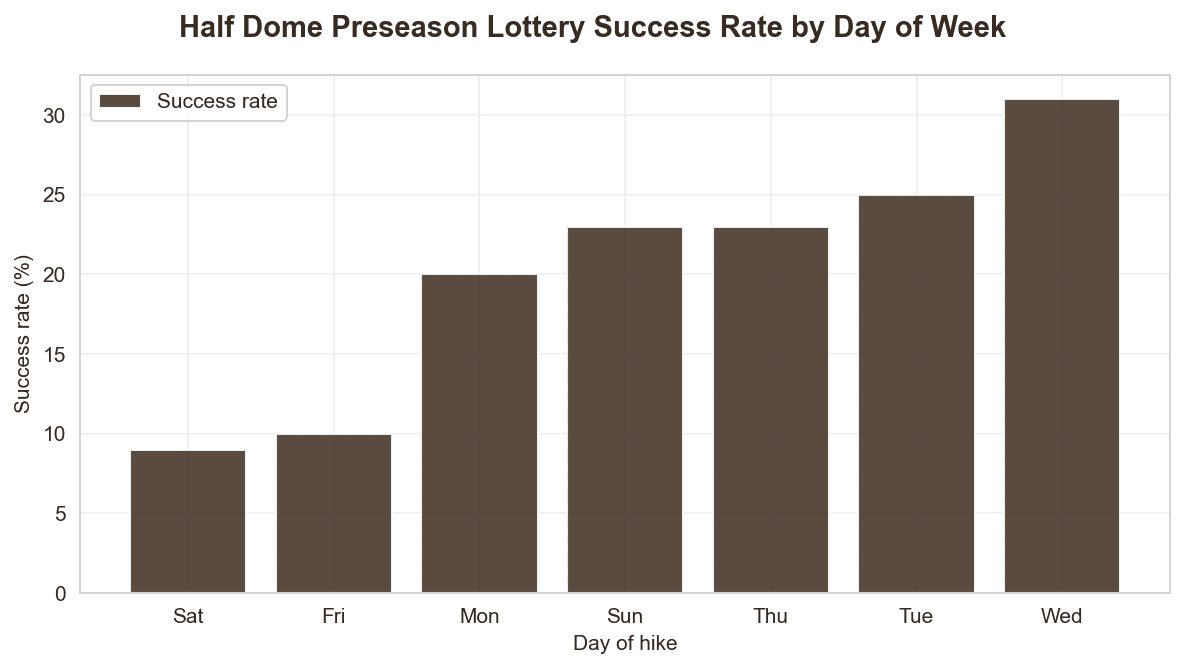
Preseason Lottery Odds by Day of Week
Based on the most recent NPS lottery data (2024, aggregated by Outdoor Status; 2023 rates were within a single percentage point):
| Day | Preseason success rate |
|---|---|
| Wednesday | 31% |
| Tuesday | 25% |
| Sunday | 23% |
| Thursday | 23% |
| Monday | 20% |
| Friday | 10% |
| Saturday | 9% |
Think of Saturday Half Dome like trying to get a dinner reservation at the one restaurant everyone heard about on TikTok. Tuesday Half Dome is the same restaurant on a random weeknight. Same food, same view, a third the line.
Preseason Lottery Odds by Month
| Month | Preseason success rate |
|---|---|
| May | 5% |
| June | 11% |
| July | 20% |
| August | 25% |
| September | 28% |
| October | 50% |
Two things jump out. May is brutal because the cable season barely opens, so the total number of permitted days is tiny. October is generous because fewer people want to hike in cold snaps and variable weather, but early October often stays dry and 60s in the Valley, with first-light starts at 40°F on the summit.
How to Improve Your Preseason Odds
Start by stacking the math in your favor. If your schedule is truly flexible, applying for a weekday in September or early October pushes your odds from the 22% overall baseline to somewhere in the 30-50% range based on recent NPS data. Applying for a Saturday in July does the opposite, dropping you into single digits.
A few practical moves:
- List all seven dates as a range, not one date. One application, seven chances at the draw. Restricting to a single date is usually self-sabotage unless that date is a shoulder-season weekday.
- Avoid July 3 to July 6, 2026. The America 250 anniversary is July 4 and demand across Yosemite will spike in ways prior-year lottery data doesn’t capture.
- Consider a smaller group. Applications for one or two people have more flexibility on tight days than a group of six. If you need six permits on a popular date, the lottery system has to hand you six out of a finite pool on that specific day.
- Pick Wednesday if you can swing mid-week. Wednesday has been the highest-odds day in the most recent NPS data (31%) by a clear margin.
After the results drop mid-April, unclaimed or cancelled permits feed back into the daily lottery pool. Plan your trip assuming you’ll enter both, not just the one you hope wins.
Practical anchor: Preseason lottery on recreation.gov, March 1 to March 31, 2026, Eastern time. $10 application fee. Up to 6 permits per application. Results mid-April.
The Daily Lottery: The Backdoor Strategy
Didn’t win preseason? The daily lottery is your second real shot, and most hikers botch the timing. Here’s the correct window: midnight to 4:00 PM Pacific, two days before your hike date. If you want to hike Saturday, you apply between midnight Thursday morning and 4:00 PM Thursday afternoon. Results post late that same night, giving you roughly 36 hours to pivot.
According to the most recent NPS lottery statistics, the daily lottery had a 19% overall success rate across 35,561 applications. Weekday daily lottery odds ran 22%. Weekend daily lottery odds ran 14%. That weekday-versus-weekend spread matters because it tells you the daily lottery isn’t some backup pool with dramatically worse odds. For weekdays, it’s nearly as good as preseason.
Daily Lottery Odds by Month
| Month | Daily lottery success rate |
|---|---|
| May | 18% |
| June | 17% |
| July | 18% |
| August | 23% |
| September | 20% |
| October | 20% |
Based on the most recent NPS lottery data (2024), aggregated by Outdoor Status.
The daily lottery math favors people already in Yosemite or nearby. You need to be able to drop everything and hike in 36 hours. If you’re flying in from out of state, the daily lottery is a bonus strategy, not a plan. If you’re road-tripping the Sierra and have four or five flexible days, it’s an excellent backup.
(Reddit thread tactic that actually works: if you strike out on the daily lottery, hike up to the subdome and ask the hikers coming down if they have an unused permit in their group. People cancel morning-of for weather, blisters, or cold feet, and a named permit holder can reassign to anyone in their registered group before they start.)
Practical anchor: Daily lottery on recreation.gov, midnight to 4:00 PM PT, two days before hike. $10 application fee. Results announced late same night.
America 250 and the July 4 2026 Surge
Why is 2026 not a normal permit year? Two things collided. First, NPS paused Yosemite’s day-use entrance reservation system for 2026. No timed-entry required for general park access, which Yosemite Conservancy and KQED have both flagged as likely to create unmanaged crowding. Second, July 4, 2026 is the 250th anniversary of the Declaration of Independence, and national parks are expected to absorb a surge of patriotic domestic travel even without marquee Yosemite programming (the big America 250 events are concentrated in Philadelphia and D.C.).
The implication for Half Dome? The preseason lottery will almost certainly see record application volume. This is editorial extrapolation rather than an NPS forecast, but the combination of no reservation valve plus anniversary demand is unprecedented. Daily lottery windows around July 3 to July 5, 2026 will be effectively uncompetitive. If July 4 is the trip you want, you’re hiking Clouds Rest or North Dome instead (more on those below) or you’re rebooking for mid-September.
For the broader context on how 2026 anniversary demand is reshaping park timing, see our write-up on America 250 crowd impact.
The inverse opportunity: if you can push your trip to mid-September through early October, you’re hiking in a post-anniversary lull against the most generous odds window on the calendar. October preseason odds in 2024 sat at 50%. Even if 2026 demand drags that down, the shoulder-season math still beats peak summer badly.
Plan B: Five Half-Dome-Caliber Hikes That Don’t Need a Permit
Sometimes the lottery breaks the wrong way. Here’s the honest truth: several of Yosemite’s best big-view hikes don’t require a permit, and two of them arguably deliver better Half Dome photographs than the cables themselves.
Clouds Rest
Start from Tenaya Lake for the shorter approach, roughly 14 miles round-trip with around 1,776 feet of gain from the lake (closer to 4,000 feet if you start from the Valley). The summit hits 9,931 feet, more than 1,000 feet higher than Half Dome itself, and the final half-mile follows a knife-edge ridge that delivers the best aerial view of Half Dome in the park. No cables, no permits, no 300-person cap. Just elevation and exposure.
Cathedral Lakes
Seven to 8.5 miles round-trip with about 1,000 feet of gain, starting from Tuolumne Meadows. Two alpine lakes under the spired face of Cathedral Peak, with an optional Class 4 scramble to the summit for peak-baggers. This is the hike you do when Half Dome is the grinder and you want the High Sierra at its most photogenic.
North Dome
9.2 miles round-trip, 2,017 feet of gain, no permit. The summit puts you face-on with Half Dome’s north face from less than a mile away. Most park photographers agree the Half Dome shot from North Dome beats the Half Dome shot from Half Dome, because on top of Half Dome you can’t actually see Half Dome.
Mount Hoffmann
Six miles round-trip, about 2,000 feet of gain, topping out at 10,845 feet. The geographic center of Yosemite with 360-degree panoramas and a Class 2 scramble at the end. Shorter than Half Dome, nearly as high, and genuinely quiet most days.
Upper Yosemite Falls
7.2 miles round-trip, 2,700 feet of gain. Comparable effort profile to Half Dome’s approach (steep switchbacks, real sweat), with Valley panoramas and the upper cataract of the tallest waterfall in North America at the turnaround. Best May through June when the falls run full.
None of these require a Half Dome permit. All of them require park admission, which runs $35 per vehicle for a 7-day pass. Our full breakdown of national park entrance fees in 2026 covers the America the Beautiful Pass math if you’re visiting more than two parks this year.
Permit Day Logistics
You won the lottery. Now what? The named permit holder or a listed alternate has to be physically present with the group, and rangers check at the base of the subdome (roughly mile 7 of the approach from Happy Isles). Bring photo ID. Bring the printed or digital permit. Do not swap in a friend who wasn’t listed on the application, because rangers do check names.
Cable conditions are weather-dependent. The NPS closes the cables for thunderstorms, wet granite, or ice. If you’re hiking in September or October, check yosemite.org and the NPS Current Conditions page the night before and the morning of. The cables go up and come down on fixed NPS schedules, but mid-season closures happen.
Start early. The approach from Happy Isles trailhead is 8 miles one-way with 4,800 feet of gain. Most hikers move before sunrise to reach the subdome by 11 AM and beat the afternoon thunderstorms that build over the Sierra crest in July and August. Sunset from the summit is unforgettable but the descent in the dark is not casual.
(Water is not available on the trail above Little Yosemite Valley. Carry 3 liters minimum. The Merced River at LYV is reliable for refilling with a filter in a dry year, but don’t count on it as your only source.)
Costs and Fees Breakdown
Half Dome permit costs are straightforward once you separate the lottery fee from the permit fee:
- Preseason lottery application: $10 non-refundable, regardless of outcome or number of dates listed.
- Permit fee if awarded: $10 per permit (per person). A group of four winning a permit pays $40 total.
- Daily lottery application: $10 non-refundable. Same $10 per permit if awarded.
- Cancellation refund: The $10 per-permit fee is refundable if cancelled by 11:59 PM Pacific the day before the hike. The $10 application fee never refunds.
Add the park entrance fee. Yosemite charges $35 per vehicle for a 7-day pass. An annual America the Beautiful Pass runs $80 and covers entrance fees at all federal recreation sites, which pays off fast if you’re doing more than two park trips in a year. To plan the rest of your trip, budget your national park trip with real per-person numbers on camping, lodging, and food.
Lodging for Half Dome trips usually means either Little Yosemite Valley backpacker camp (wilderness permit required, separate system) or a Valley campground like Upper Pines, North Pines, or Lower Pines. Valley campgrounds book through recreation.gov five months in advance on a rolling window, with most summer dates snapped up within the first hour.
Get Free Park Alerts
Permit windows, fee-free days, campsite openings, and seasonal condition reports, delivered to your inbox. Join thousands of park planners who never miss a window.
FAQ
What are the odds of winning the preseason Half Dome lottery?
NPS has not yet published 2025 statistics as of April 2026, so the most recent complete data set is 2024. Across 35,289 applications that year, the overall preseason success rate was 22%. Odds varied sharply by date: Wednesday hit 31%, Saturday was 9%, October was 50%, May was 5%. Because 2023 rates were within a single percentage point of 2024, treat these as reliable directional guidance for 2026 planning until NPS releases 2025 figures.
When does the 2026 Half Dome preseason lottery open and close?
The preseason lottery is open March 1 to March 31, 2026, Eastern time. Apply on recreation.gov. Results are announced in mid-April, and awarded permits are billed at $10 per permit at that time.
How does the Half Dome daily lottery work?
The daily lottery runs midnight to 4:00 PM Pacific, two days before your hike date. Apply on recreation.gov for $10 per application. Results are announced late the same night. In the most recent NPS data, weekday odds ran 22% and weekend odds ran 14%.
How much does a Half Dome permit cost per person?
$10 per person if you win a permit, plus the $10 non-refundable application fee per lottery entry. The per-permit fee is refundable if you cancel by 11:59 PM Pacific the day before the hike.
Can I hike Half Dome without a permit?
No. The cable route requires a permit anytime the cables are up, which is projected to run May 22 to October 13, 2026. Hiking without one violates 36 CFR 1.6, with a statutory max of $5,000 and up to 6 months in jail. Hikers have reported $280 field citations in practice. Rangers check permits at the base of the subdome.
Will America 250 make 2026 Half Dome permits harder to get?
Almost certainly. NPS paused Yosemite’s day-use reservation system for 2026, and July 4, 2026 is the 250th anniversary of the Declaration of Independence. Preseason application volume is projected to hit record levels, and daily lottery windows around July 3 to July 5 will be effectively uncompetitive. This is an editorial projection, not an NPS forecast, but the demand signals point one direction.
What if I don’t win either lottery?
Stack a Plan B. Clouds Rest, North Dome, Mount Hoffmann, Cathedral Lakes, and Upper Yosemite Falls all deliver big-view Sierra hikes with no permit requirement. North Dome in particular gives you the best photograph of Half Dome in the park. You can also hike up to the Half Dome subdome without a permit and ask descending groups about unused permits in their registered party.
When are the Half Dome cables up in 2026?
Projected May 22 to October 13, 2026. The NPS rule is the Friday before Memorial Day through the day after the second Monday in October. Exact 2026 dates are pending official NPS confirmation, and weather delays the put-up or forces early take-down in some years.
Which weekdays have the best Half Dome lottery odds?
Wednesday has been the best day in the most recent NPS data at 31% preseason success, followed by Tuesday (25%), Sunday (23%), and Thursday (23%). Saturday (9%) and Friday (10%) were the worst.
Can I transfer my Half Dome permit to a friend?
No. The named permit holder or a listed alternate has to be present with the group at the subdome ranger check. You can add or swap names within your registered group on recreation.gov before the hike, but you can’t hand the permit off to someone outside the application.
Based on the most recent NPS lottery data (2024), aggregated by Outdoor Status. 2023 rates were within a single percentage point.
The Bottom Line
So which lottery should you enter, and when? Here’s the decision tree.
If your dates are flexible, enter the preseason lottery on March 1, 2026. List a range of seven weekday dates in September or early October. Skip the July 4 window. Your odds sit north of 30% on the best date picks.
If your dates are fixed (summer vacation, wedding weekend, group trip that can’t move), enter the preseason lottery anyway, then plan to enter the daily lottery from your hotel Wi-Fi two mornings out. Have a Plan B hike loaded in your pack: Clouds Rest if you want higher than Half Dome, North Dome if you want the best photo of Half Dome, Mount Hoffmann if you want 360 panoramas.
The stacked strategy (preseason + daily + Plan B) is how a Half Dome permit 2026 actually lands in your pack without a nine-month wait. Half Dome is one of about 20 permit-regulated experiences in the park system that reward the people who do the homework. Park Adventurer’s planning tools, reservation calendars, and 2026 anniversary crowd maps help you do that homework in an hour instead of a weekend.
Apply early. Hike hard. And if the lottery breaks the wrong way, the view from North Dome is waiting.