Roll up to the Grand Canyon’s South Entrance on a Tuesday in June and the math hits before the view does. The vehicle fee reads $35, same as last summer. But the ranger at the booth now asks where you live, and whether you’re traveling with anyone 16 or older who isn’t a US resident. Because in 2026, that single question can add $100 per person to your entry, or nothing at all, depending on what’s in your wallet.
This is the first year the entrance-station conversation looks different for every visitor. A new tiered pass system, a $100 surcharge that only applies at 11 parks, and a rebuilt fee-free calendar have moved so many pieces at once that even rangers are spending the first few months re-explaining the rules. Here’s what actually changed, what it costs, and how to decide – in plain math – whether you need a pass.
Quick Answer: 2026 National Park Fees at a Glance
- Standard entrance fee: Most fee-charging parks run $30-$35 per vehicle for a 7-day pass. Motorcycle and per-person rates are lower.
- New $100 nonresident surcharge (effective January 1, 2026): Applies to non-US residents age 16+ at 11 high-demand parks, on top of the standard entrance fee. Pass holders are exempt.
- America the Beautiful Pass: $80/year for US residents, $250/year for non-US residents. Both versions exempt the holder (and everyone in their vehicle at a drive-in entrance) from the $100 surcharge.
- Fee-free days: 8 days in 2026, US residents only. The $100 surcharge is not waived on fee-free days.
- Roughly 108 of 430+ NPS sites charge any entrance fee at all. The rest – national monuments, historic sites, most seashores – are free to enter year-round.
- Not sure if the $80 pass is for you? See our America the Beautiful Pass 2026 deep-dive.
How National Park Entrance Fees Work in 2026
National park entrance fees come in three flavors, and the choice between them usually comes down to how you’re arriving.
The vehicle fee covers a private, non-commercial car or truck and everyone riding in it – usually up to 15 people, depending on the park. It’s a 7-day pass, so leaving the park and coming back later in the week doesn’t cost extra. The motorcycle fee covers one or two motorcycles and up to 4 riders total. The per-person fee applies if you’re walking in, biking in, or arriving by shuttle without a car, and it’s charged individually for each person age 16 and over.
About 108 of the 430-plus National Park Service sites charge an entrance fee of any kind. The rest – most national monuments, historic sites, recreation areas, and parkways – are free. So when you see “national park fees,” think of it as a fee that applies to a specific tier of high-demand destinations, not a blanket cost across the system.
The wrinkle in 2026 is residency. For the first time, 11 parks now charge non-US residents a $100-per-person surcharge on top of the standard entrance fee (DOI press release). Green card holders count as residents and don’t pay the surcharge. Everywhere else in the system, fees are the same for everyone.
The 11 Parks That Charge the $100 Nonresident Surcharge
Effective January 1, 2026, non-US residents age 16 and over must pay a $100 nonresident fee to enter 11 specific parks, on top of the standard entrance fee – unless they hold an Annual Pass or America the Beautiful Pass. The exact clause, verbatim from every one of the 11 park fee pages, reads: “Each non-US resident aged 16 and older visiting [PARK] National Park must pay a $100 nonresident fee (in addition to the standard entrance fee), unless admitted with an Annual or America the Beautiful Pass.”
Here are the 11, with verified 2026 fees:
| Park | State | Vehicle | Motorcycle | Per-Person (16+) | Surcharge |
|---|---|---|---|---|---|
| Acadia | ME | $35 | $30 | $20 | +$100 |
| Bryce Canyon | UT | $35 | $30 | $20 | +$100 |
| Everglades | FL | $35 | $30 | $20 | +$100 |
| Glacier | MT | $35 summer / $25 winter | $30 / $20 | $20 / $15 | +$100 |
| Grand Canyon | AZ | $35 | $30 | $20 | +$100 |
| Grand Teton | WY | $35 | $30 | $20 | +$100 |
| Rocky Mountain | CO | $35 (7-day) / $30 (1-day) | $30 / $25 | $20 / $15 | +$100 |
| Sequoia & Kings Canyon | CA | $35 | $30 | $20 | +$100 |
| Yellowstone | WY | $35 | $30 | $20 | +$100 |
| Yosemite | CA | $35 | $30 | $20 | +$100 |
| Zion | UT | $35 | $30 | $20 | +$100 |
A few things worth flagging. Sequoia and Kings Canyon count as one unit for fee and surcharge purposes – a single pass admits you to both parks. Glacier has a unique summer/winter split, with fees dropping from November 1 through April 30. Rocky Mountain is the only surcharge park still selling a discounted one-day vehicle pass. And Yosemite is now cashless at all entrance stations – credit card, debit, or mobile payment only, no cash accepted.
The wording matters here: the surcharge applies to non-US residents, not non-US citizens. Green card holders and other permanent US residents are exempt. If you live in the US and pay US taxes, you pay the standard fee regardless of passport.
A common point of confusion: several parks that the 2025 rumor cycle flagged as surcharge candidates are not on the list. Arches, Canyonlands, and Olympic all charge the standard $30 vehicle fee with no nonresident surcharge (NPS/arch, NPS/cany, NPS/olym). Joshua Tree, Shenandoah, Death Valley, Mount Rainier, and Hawaii Volcanoes also charge the standard fee with no surcharge. If you see a blog post or Reddit thread claiming the surcharge applies to a park not on the table above, it’s wrong.
The America the Beautiful Pass in 2026: $80 for Residents, $250 for Nonresidents
This is the part of the 2026 rules that changes everything for pass math, and the part that gets explained wrong most often. As of January 1, 2026, the America the Beautiful Pass is sold in two tiers.
Resident Annual Pass: $80
The $80 Annual Pass is the same product it’s been for years, now formally designated the resident version. It’s available to US citizens and permanent residents (green card holders included), and it covers entrance and standard day-use fees at roughly 2,000 federal recreation sites – every fee-charging national park, plus sites run by the Forest Service, Bureau of Land Management, Fish and Wildlife Service, Bureau of Reclamation, and Army Corps of Engineers.
It’s valid for the pass holder and everyone in the vehicle at drive-in entrances, or the pass holder plus 3 adults at per-person entrances. It’s valid for 12 months from the month of purchase (so a pass bought in July 2026 runs through July 2027). And – this is the new part for 2026 – it exempts the pass holder from the $100 nonresident surcharge at the 11 surcharge parks, which is a non-event for most US resident holders but matters if you’re traveling with a non-US resident companion. More on that in a moment.
Nonresident Annual Pass: $250 (new for 2026)
The $250 Nonresident Annual Pass is the genuinely new product in 2026. Parallel to the resident version, it covers the same federal sites with the same duration and vehicle rules. What it also does – and this is why the price difference exists – is exempt the holder from the $100 surcharge at all 11 surcharge parks.
Think of it like a toll road and an E-ZPass. You can pay per entry and get hit for $100 at every surcharge park you visit, or buy the pass upfront and roll through without the surcharge. Whether that math works depends on how many surcharge parks you plan to hit, which we’ll walk through in the next section.
Other Pass Types (Condensed)
The other pass types haven’t changed for 2026:
- Senior Annual: $20 for US residents age 62+, valid one year.
- Senior Lifetime: $80 one-time payment for US residents 62+, valid for life.
- Military Annual: Free for current US military and their dependents.
- Military Lifetime: Free for veterans and Gold Star Family members.
- Access Pass: Free for US residents with a permanent disability, lifetime validity.
- 4th Grade Pass: Free for current US 4th graders, covers entry for the school year plus the following summer.
- Volunteer Pass: Free for people who log 250+ hours with federal recreation sites.
All of these pass types include the same vehicle coverage as the standard Annual Pass, which means they also exempt the holder from the $100 surcharge at the 11 surcharge parks.
Where to Buy
Every pass type is available at recreation.gov/pass or at staffed entrance stations. The $80 Resident Annual is also sold at REI and some outdoor retailers. Buying online before a trip saves time at the entrance booth (expect entrance-station confusion the first few months of 2026 as both rangers and visitors adjust).
Should You Buy a Pass? A Decision Tree for 2026
The pass math flipped hard in 2026 for non-US residents, and stayed roughly the same for US residents. Here’s how to think about it for each.
If You’re a US Resident
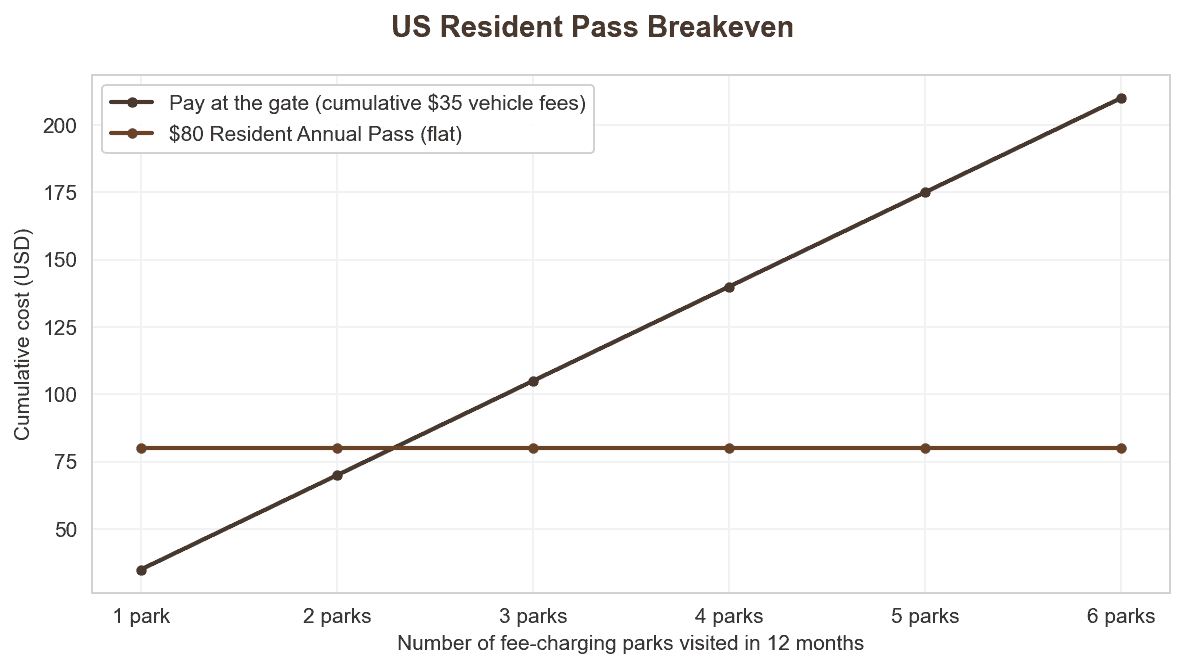
The $80 Annual Pass breaks even at three fee-charging parks in 12 months. That’s the whole calculation. If you’re going to hit Yellowstone and Grand Teton on one trip and Zion later in the year, that’s 3 parks and $105 in vehicle fees – the pass pays for itself and then some.
If your 2026 plans include only one or two fee-charging parks, skip the pass and pay at the gate. If all your target parks are free (think Great Smoky Mountains, Cuyahoga Valley, Glacier Bay, most national monuments and seashores), obviously skip it. And if you’re mixing fee-charging and free parks, do the math: count up the vehicle fees at the fee-charging ones, compare to $80, and decide.
A couple of shortcuts worth knowing. If you’re 62 or older, the Senior Annual at $20 or the Senior Lifetime at $80 one-time is almost always the better buy. Active military and dependents pay nothing. Fourth-graders in the 2025-26 and 2026-27 school years get a free pass that covers their vehicle.
If You’re a Non-US Resident
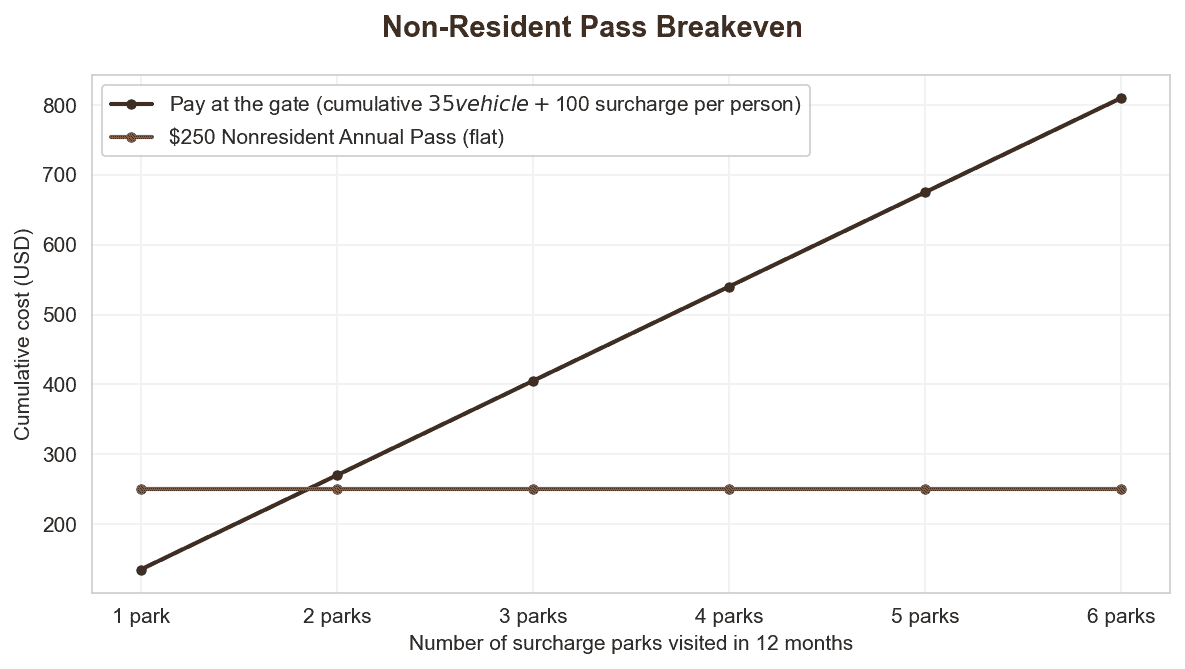
This is where the math got interesting in 2026. The $250 Nonresident Pass breaks even at three surcharge parks in 12 months – because the surcharge alone is $100 per person per park, and three visits means $300 in surcharges without the pass (on top of the standard entrance fees).
So the decision tree runs:
- Visiting 3 or more surcharge parks? Buy the $250 pass. You’ll come out ahead before the fees even start, and you get the free entry at every federal recreation site on top.
- Visiting 2 surcharge parks plus some free or non-surcharge parks? Run the numbers, but for most travelers the pass is still the better buy once you factor in standard entrance fees at the other parks. $200 in surcharges plus $70 in vehicle fees already ties the pass.
- Visiting just 1 surcharge park plus non-surcharge parks? Pay the $100 at the gate and skip the pass. You’d need a lot of other fee-charging stops to make $250 pencil out.
- Visiting only non-surcharge parks? Same math as for US residents – compare the vehicle fees you’d otherwise pay to $250 and decide. Usually it’s cheaper to pay at the gate unless you’re visiting 9+ fee-charging parks in 12 months.
One useful test: if your 2026 US trip includes both Yellowstone and Grand Teton (back-to-back is the common Wyoming loop), plus even one other surcharge park, you’re past breakeven.
2026 Fees at the 20 Most-Visited Parks
Every row in this table was verified against its nps.gov fee page in April 2026. Parks flagged with (+$100) carry the nonresident surcharge; everywhere else, fees are the same for all visitors.
Rankings based on 2024 NPS visitation data – NPS hasn’t released 2025 totals yet.
| # | Park | Vehicle | Motorcycle | Per-Person | Notes |
|---|---|---|---|---|---|
| 1 | Great Smoky Mountains | – | – | – | Parking tag only: $5/day, $15/week, $40/year |
| 2 | Grand Canyon (+$100) | $35 | $30 | $20 | Standard 7-day pass |
| 3 | Zion (+$100) | $35 | $30 | $20 | Valley shuttle required Mar-Nov |
| 4 | Rocky Mountain (+$100) | $35 (7-day) / $30 (1-day) | $30 / $25 | $20 / $15 | Timed-entry permit separate |
| 5 | Yellowstone (+$100) | $35 | $30 | $20 | Covers park for 7 days |
| 6 | Yosemite (+$100) | $35 | $30 | $20 | Cashless entrance stations |
| 7 | Acadia (+$100) | $35 | $30 | $20 | Cadillac Summit reservation separate |
| 8 | Grand Teton (+$100) | $35 | $30 | $20 | Bundles with Yellowstone on a single Annual Pass |
| 9 | Joshua Tree | $30 | $25 | $15 | No surcharge |
| 10 | Olympic | $30 | $25 | $15 | No surcharge |
| 11 | Cuyahoga Valley | Free | Free | Free | No entrance fee |
| 12 | Glacier (+$100) | $35 summer / $25 winter | $30 / $20 | $20 / $15 | Reservation system changed Feb 2026 |
| 13 | Bryce Canyon (+$100) | $35 | $30 | $20 | Shuttle runs Apr-Oct |
| 14 | Hawaii Volcanoes | $30 | $25 | $15 | No surcharge |
| 15 | Indiana Dunes | $25 | $20 | $15 | Lowest vehicle fee of any Top 20 |
| 16 | Sequoia & Kings Canyon (+$100) | $35 | $30 | $20 | Single pass covers both parks |
| 17 | Death Valley | $30 | $25 | $15 | Cashless; credit/debit only |
| 18 | Shenandoah | $30 | $25 | $15 | Skyline Drive |
| 19 | Mount Rainier | $30 | $25 | $15 | Paradise area timed entry separate |
| 20 | New River Gorge | Free | Free | Free | No entrance fee; designated a national park in 2020 |
All fees verified April 2026 against each park’s official nps.gov/[code]/planyourvisit/fees.htm page. The NPS fee schedule lists all ~108 fee-charging parks if yours isn’t on this Top 20.
A pattern worth noticing: the 11 surcharge parks all sit at the $35 vehicle fee, while most non-surcharge parks charge $30 or less. The surcharge wasn’t designed in a vacuum – it was layered onto the highest-demand parks, which were already at the top of the fee schedule.
2026 Fee-Free Days (8 Days, US Residents Only)
2026 brings eight fee-free days, up from five in 2025. Here’s the full list, verified against the DOI press release and confirmed on individual park pages:
- February 16, 2026 – Presidents Day
- May 25, 2026 – Memorial Day
- June 14, 2026 – Flag Day / President Trump’s birthday
- July 3-5, 2026 – Independence Day weekend (3 days)
- August 25, 2026 – NPS 110th Birthday
- September 17, 2026 – Constitution Day
- October 27, 2026 – Theodore Roosevelt’s birthday
- November 11, 2026 – Veterans Day
Two important caveats before you start booking trips around these dates.
Fee-free days in 2026 apply to US residents only. This is new. In prior years, fee-free days waived entrance fees for everyone. For 2026, the Department of the Interior restricted the benefit to US residents, and the $100 nonresident surcharge is not waived on any fee-free day. A non-US resident arriving at Yellowstone on July 4 still pays the $100 surcharge, the only savings being the standard $35 vehicle fee.
Fee-free means entrance fees only. Camping fees, tour fees, backcountry permits, and the Great Smoky Mountains parking tag are not waived. If you’re planning a July 4 visit to the Smokies, you still need a parking tag.
A quick note on the America 250 celebration: the Independence Day window in 2026 is 3 days (July 3-5), not a 10-day window. America 250 programming – historical events, ranger-led tours, themed demonstrations – runs across a longer span and involves hundreds of events at parks across the country, but the actual fee-free status is limited to that three-day weekend. For the full programming calendar, see our America 250 national parks guide.
If you’re planning specifically around fee-free dates, we keep a running breakdown at national park free days 2026.
Free Parks (and Free Ways to Visit Fee-Charging Ones)
Despite the attention the fee-charging parks get, most of the National Park System is free. Roughly 322 of the 430-plus NPS units charge no entrance fee of any kind – including several of the most historically significant and most visited sites in the country.
National Parks with No Entrance Fee in 2026
Roughly 20 national parks charge nothing to enter. The biggest names: Biscayne (FL), Channel Islands (CA), Congaree (SC), Cuyahoga Valley (OH), Great Basin (NV), Hot Springs (AR), Mammoth Cave (KY), New River Gorge (WV), North Cascades (WA), Redwood (CA), Voyageurs (MN), and White Sands (NM). Alaska alone accounts for 7 free parks: Gates of the Arctic, Glacier Bay, Katmai, Kenai Fjords, Kobuk Valley, Lake Clark, and Wrangell-St. Elias.
A useful pattern: most parks whose primary access is boat or aircraft are free. If your trip leans toward Alaska, the Midwest, or the Mid-Atlantic, your entrance-fee budget can stay close to zero.
The Parking-Tag Exception
Great Smoky Mountains is the most-visited park in the country and free to enter, but you need a parking tag for any vehicle parked more than 15 minutes. It’s $5 per day, $15 per week, or $40 per year, same rate for everyone, and it’s not waived on federal fee-free days.
Every national monument, historic site, and national memorial in the NPS system is free to enter. The full list of the ~108 fee-charging parks and the 320+ free sites lives on nps.gov.
Vehicle vs. Per-Person Fees (and When to Walk In)
The fee structure rewards arriving with a full car and penalizes solo visitors who drive. If you’re traveling alone at a surcharge park, the per-person fee of $20 beats the $35 vehicle fee – as long as you can legitimately enter on foot, bike, or shuttle.
The wrinkle: many parks require a vehicle just to reach the entrance, so walking in isn’t always practical. Where the walk-in math works best is at parks with robust shuttle systems (Zion’s Springdale shuttle, Acadia’s Island Explorer, Grand Canyon’s Tusayan-to-Visitor-Center shuttle), where you can park outside and ride in. Cyclists get the same discount. At surcharge parks, non-resident cyclists still owe the $100 surcharge as individuals.
Why the Surcharge Exists (In Two Paragraphs)
The Department of the Interior’s case for the surcharge, as presented in its January 2026 press release, rests on three arguments: the revenue is earmarked for infrastructure backlogs at high-demand parks; the US is following a precedent already set by several other countries that charge nonresidents differently; and the fee acts as a modest demand management tool at parks that are functionally at capacity in peak season. The DOI also frames the $80 resident pass as the “greatest benefit” for American taxpayers who support the park system year-round.
The criticism has been active from the day the surcharge was announced. International tourism groups have objected publicly, some travel communities have questioned whether a residency-based entrance fee sits comfortably within the NPS’s public-lands ethos, and concerns flagged during the 2025 comment period – enforcement at entrance stations, passenger-exemption confusion, and impact on gateway communities that depend on international visitors – remain open as the policy enters its first full season.
How to Pay + Practical Tips
Every staffed entrance station accepts credit and debit cards. Most accept cash, but an increasing number are going cashless – Yosemite and Death Valley already require electronic payment, and more are likely to follow before summer. Mobile wallet payments work at the majority of stations now.
A few practicalities worth knowing before you pull up:
- Buy your pass online ahead of time if you already know you want one. Recreation.gov ships a physical card you can present at the booth.
- Reservations are not fees. A timed-entry permit at Rocky Mountain, Glacier, or Arches is a separate system – you pay both. See our 2026 national park reservations guide.
- The 7-day validity is a gift. If you’re visiting parks close together (Grand Teton and Yellowstone, or Bryce and Zion), a single entry fee often covers both on a one-week loop.
- Entrance-station queues are longest between 9am and 11am. Arriving before 8am or after 2pm typically means no line, even at Zion in July.
- Expect entrance-station confusion the first few months of 2026. Both visitors and rangers are still settling into the new residency workflow. Having your pass visible and your ID handy speeds things up.
Budget Examples: Two Worked Trips
Two common multi-park trips, with 2026 math.
US Resident, Utah Mighty 5 (Arches, Bryce, Canyonlands, Capitol Reef, Zion)
Each of the five parks charges $30-$35 per vehicle. Paying at each gate would run $35 + $30 + $30 + $30 + $35 = $160 in vehicle fees alone. The $80 Annual Pass breaks even at park three and saves $80 over the trip. For most US resident visitors planning the Mighty 5, the pass is the clearly better buy. Budget $80 for pass; the trip’s other costs (camping, lodging, food, fuel) are separate from fees.
Non-US Resident, Utah Trip with Bryce and Zion
Same itinerary, different math. Bryce and Zion are both surcharge parks, so a non-resident pays $35 + $100 at each – $270 in vehicle and surcharge fees for just those two parks. The other three (Arches, Canyonlands, Capitol Reef) are standard $30 each, another $90. Total at the gate: $360.
With the $250 Nonresident Annual Pass? $250 flat, no surcharge, no vehicle fees at any of the five. The pass saves $110 on this trip alone, and it’s still valid for 12 months afterward if there’s any chance of another US park visit in the year.
The breakeven for a non-resident traveler is even simpler than the math suggests: if your US trip includes any two surcharge parks plus any third fee-charging park, the pass almost certainly wins. If it includes three or more surcharge parks, the pass is a no-brainer. For a rough-cost estimate of the rest of a park trip (lodging, fuel, food, camping, activities), see our 2026 national park trip cost breakdown.
Get Free Park Alerts
Permit windows, fee-free days, campsite openings, and seasonal condition reports, delivered to your inbox. Join thousands of park planners who never miss a window.
Frequently Asked Questions
How much does it cost to enter Yellowstone in 2026?
$35 per private vehicle for a 7-day pass, $30 per motorcycle, $20 per person (age 16+) for walk-in or bicycle entry. Non-US residents pay an additional $100 per person age 16+ on top of those fees, unless admitted with an Annual or America the Beautiful Pass. An America the Beautiful Annual Pass admits you to both Yellowstone and Grand Teton. A single-park vehicle pass purchased at Yellowstone does not cover Grand Teton.
Do international visitors pay more at national parks in 2026?
At 11 specific parks, yes. Non-US residents age 16 and over pay a $100 surcharge on top of the standard entrance fee at Acadia, Bryce Canyon, Everglades, Glacier, Grand Canyon, Grand Teton, Rocky Mountain, Sequoia & Kings Canyon, Yellowstone, Yosemite, and Zion. At the other ~97 fee-charging parks, fees are identical for all visitors regardless of residency. Pass holders are exempt from the surcharge everywhere.
Is the America the Beautiful Pass worth it in 2026?
For US residents, the $80 pass breaks even at three fee-charging parks in 12 months. For most travelers planning any multi-park trip, it pays for itself quickly. For non-US residents, the new $250 pass breaks even at three surcharge parks – or at two surcharge parks plus a couple of other fee-charging stops. If your 2026 trip touches more than one surcharge park, the pass almost certainly wins.
Which national parks are free in 2026?
Roughly 20 national parks charge no entrance fee at all in 2026, including Cuyahoga Valley, Great Basin, Hot Springs, Mammoth Cave, New River Gorge, North Cascades, Redwood, the 7 free Alaska parks (Denali is the only fee-charging one), and several others. Great Smoky Mountains is technically free to enter but requires a parking tag ($5 daily, $15 weekly, $40 annual) for any vehicle parked more than 15 minutes.
When are fee-free days in 2026?
Eight days: February 16 (Presidents Day), May 25 (Memorial Day), June 14 (Flag Day), July 3-5 (Independence Day weekend), August 25 (NPS 110th Birthday), September 17 (Constitution Day), October 27 (Theodore Roosevelt’s birthday), and November 11 (Veterans Day). Fee-free status applies to US residents only in 2026.
Do I need a reservation AND pay an entrance fee?
Yes, at parks that require timed-entry or day-use reservations (including Rocky Mountain, Glacier, Arches, Haleakala Crater, Cadillac Summit at Acadia, and several others seasonally). The reservation is a separate system from the entrance fee – you pay both. The reservation is a small separate charge, typically a couple of dollars, collected by recreation.gov when you book; the entrance fee or your pass covers the actual park entry.
Does the $100 surcharge apply on fee-free days?
No fee-free day waives the $100 surcharge. Fee-free days only waive the standard entrance fee. A non-US resident visiting Grand Canyon on July 4 still pays $100 per person; they just don’t pay the additional $35 vehicle fee.
Does the America the Beautiful Pass cover the $100 surcharge?
Yes. This is the most important clarification in 2026. Both the $80 Resident Annual Pass and the $250 Nonresident Annual Pass exempt the holder from the $100 surcharge at all 11 surcharge parks. The exact NPS language, repeated on every surcharge park’s fee page: “unless admitted with an Annual or America the Beautiful Pass.” The same exemption applies to Senior, Military, Access, 4th Grade, and Volunteer passes.
What is the $250 Nonresident Annual Pass?
A new pass introduced on January 1, 2026, sold alongside the $80 Resident Annual Pass. The Nonresident version is priced at $250 and is the pass non-US residents need to buy if they want Annual Pass coverage. It provides the same entrance and day-use coverage as the resident pass at roughly 2,000 federal recreation sites, with one critical added benefit: it exempts the holder from the $100 surcharge at all 11 surcharge parks. Available at recreation.gov/pass or any staffed entrance station.
If I enter a park as a passenger in a pass holder’s vehicle, do I pay the $100 surcharge?
The America the Beautiful Pass is a per-vehicle pass at drive-in entrances, meaning it admits the pass holder and everyone in the vehicle on a single entry. So a non-US resident riding in a vehicle with a pass-holding companion (resident or nonresident) is admitted under that pass and does not pay the surcharge. This is how the per-vehicle pass works, not a workaround. At walk-in or bicycle entrances, the per-person rules apply individually and each visitor’s residency status is assessed separately.
Last updated: April 17, 2026. All NPS fee data verified against nps.gov.